Change Request – Add - Form Layout and Navigation
 Updated
Suggested Prior Reading
Click here for Grouped List View
OR
Click here for Simple List View
Adding a New Change Request
This help explains the layout and how to navigate the New Change Request form.
This form can be invoked from the Change Requests List OR the Contracts - List of all Change Requests and there are also different views that can be set for All Change Requests Lists. See All Change Requests Lists - Views Examples to determine which view is set for the organization, then see the above Suggested Prior Reading for the applicable view and list).
For either of the lists or for either View, once the add function is invoked, the Change Request - Add form is the same.
Change Requests are made up of multiple components:
- General Information (such as Client, Title, Number, Scope, Revenue Source and Description)
- Schedule of Values (the details about the Change Request)
- Financial Markups (for the Change Request)
Each of these components display on a form that has a static top section and static bottom section, then the middle section changes to display the component selected.
Form Navigation Menu Options (that display in the static top section) are used to change what components display in the middle section.
This help describes the:
- The top of the Change Request Add Form (which doesn't change)
- The bottom of the Change Request Add Form (which doesn't change)
- The Form Navigation Menu Options (to toggle between components)
- The middle section of the Change Request Add Form (which changes depending on what component is selected)
Top of the New Change Request Form
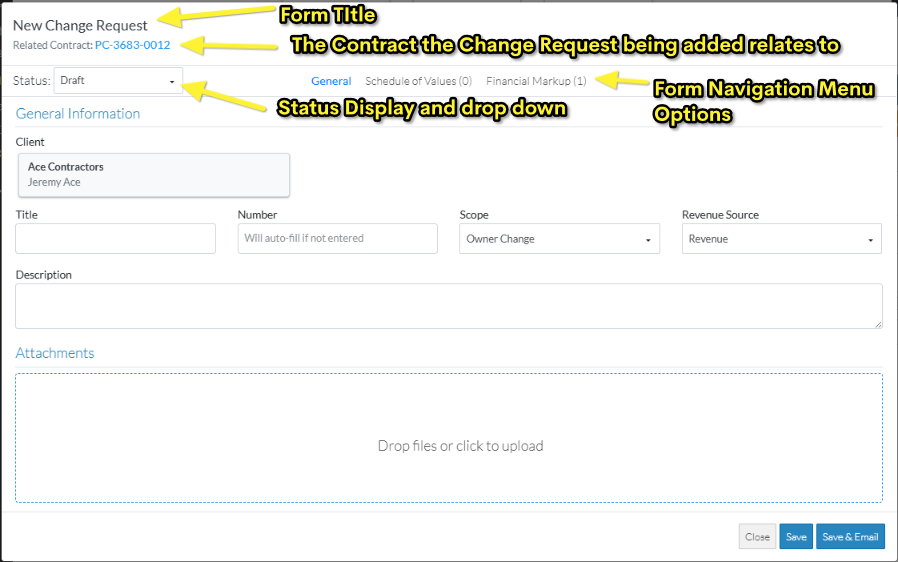
When adding a Change Request, the New Change Request form displays that as the title.
Below that, the Related Contract for the Change Request displays. The Contract Number displays in blue text and the blue text can be clicked on to leave this form and go to the Contract - View/Edit form (see Contracts - View/Edit for more information on the form displayed if the Contract Number is clicked on).
Below that, the New Change Request form has the following:
- Status - where the Status is displayed and can be changed (if required).
- Form Navigation Menu Options - this is used to toggle between the different components of the Change Request.
Bottom Section of the New Change Request Form
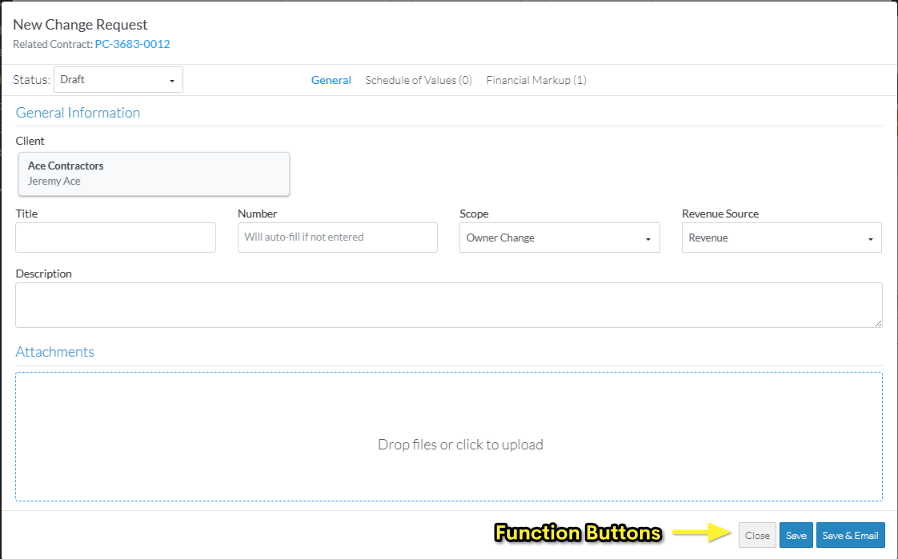
The Function Buttons to Close the form, Save the Change Request (and all its Components) or Save and Email the Change Request (and all its Components) are displayed at the bottom.
Form Navigation Menu Options (to toggle between components)
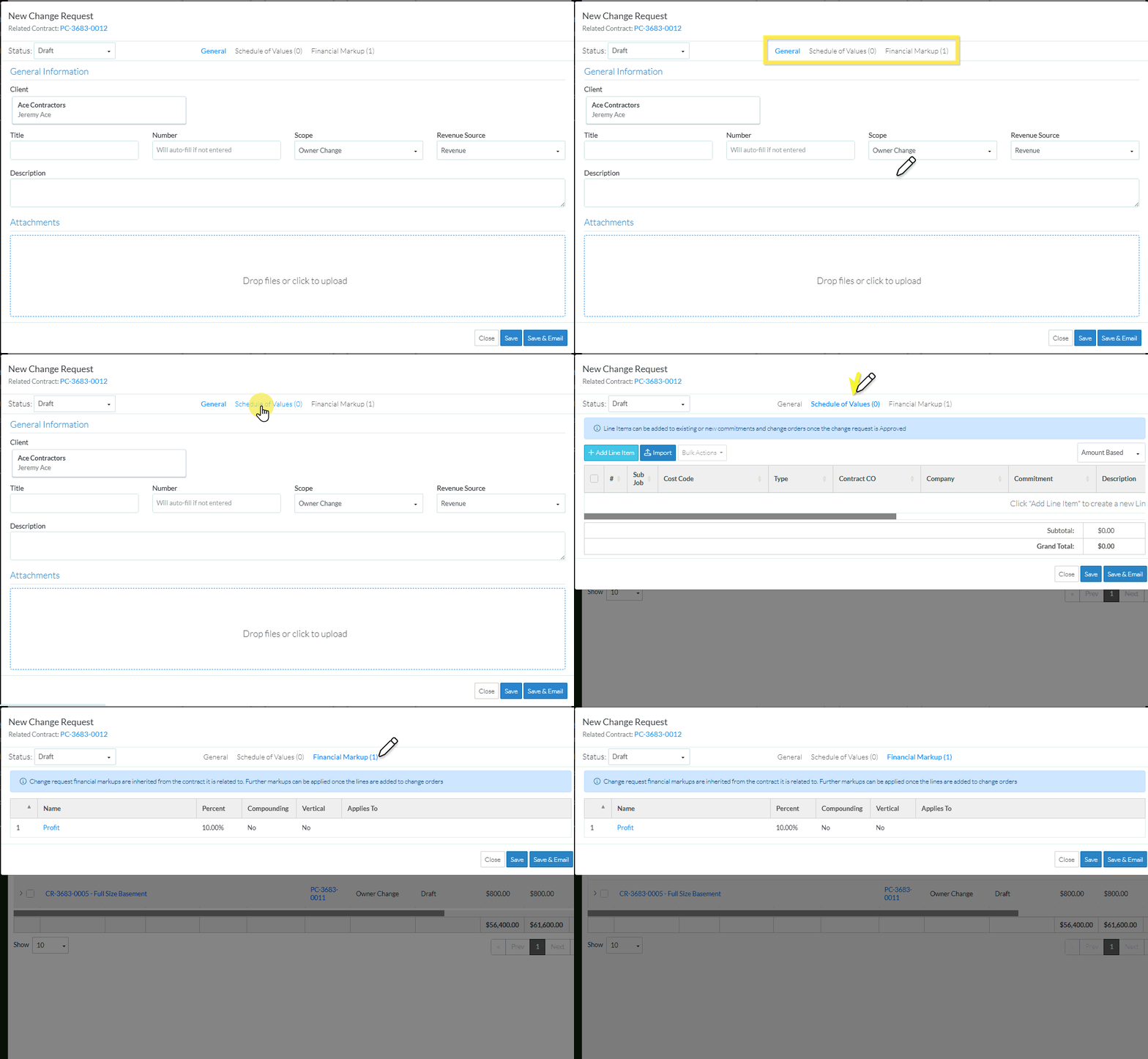
The Form Navigation Menu options are used to toggle between the different components of the Change Request.
The example below show all options available. Depending on the Permissions set for the user, not all menu options may display. If a menu option doesn't display, it means the user does not have permissions to access that.
The currently selected component is highlighted in blue writing.
Click on the text on the Form Navigation Menu to toggle between the components.
The menu options may appear with a () and a number next to it. This is the number of items in that section.
When toggling between components, the top and bottom static sections of the form don't change.
The Change Request can be saved, saved and emailed or closed when any of the Change Request components are displayed (and the function either cancels all changes on all forms and components if closed, or saves changes on all forms and components if saved or saved and emailed).
The Status can be changed when any of the Change Request Components are displayed. However, although the new status selected is displayed, the functionality available during this add session won't be impacted by the Status change. The functionality available will still be for the Draft Status until the Change Request is saved.
Middle Section of the New Change Request Form
The middle section of the New Change Request form, changes depending on what Component is selected on the Form Navigation Menu options (see above).
The General component is displayed by default when the New Change Request function is initiated.
Next Steps
Set the Status if required, see Change Request - Add - Status.
Enter or Change general information about the Change Request, see Change Request - Add - General.
Create or manage Change Request Schedule of Values, see Change Request - Schedule of Values - Overview.
Create or manage Change Request Financial Markups, see Change Request - Financial Markups - Overview.
